How Hot and How Cold Can Medaka Go?
Medaka survive roughly 40 to 85°F when changes are gradual, and they do best from the low 60s to the high 70s. That is an enormous range for a small fish and the main reason they suit unheated tanks and outdoor tubs. But comfortable, tolerated, and survivable are three different things, and the number on a thermometer matters less than how fast it got there.
The three bands
| Band | Roughly | What is happening |
|---|---|---|
| Dangerous cold | Below freezing, solid | Water freezing through is what kills, not cold itself |
| Slow and cold | Cold water, roughly the low 50s and below | Slowing down and eating less, then mostly resting near the bottom as it gets colder |
| Does best | Low 60s to high 70s F | Active, feeding well, coloring up |
| Breeding | Needs long days (about 13 to 14 hours of light) and water in the mid 60s or warmer | Spawning picks up as the water warms, with strain differences |
| Stressed heat | Mid 80s and up | Oxygen dropping, fish near the surface |
| Dangerous heat | Sustained 90s | Oxygen runs short in still water, especially overnight; real risk |
Treat these as bands, not thresholds. A fish that has cooled gradually over weeks handles temperatures that would kill one moved there in an afternoon.
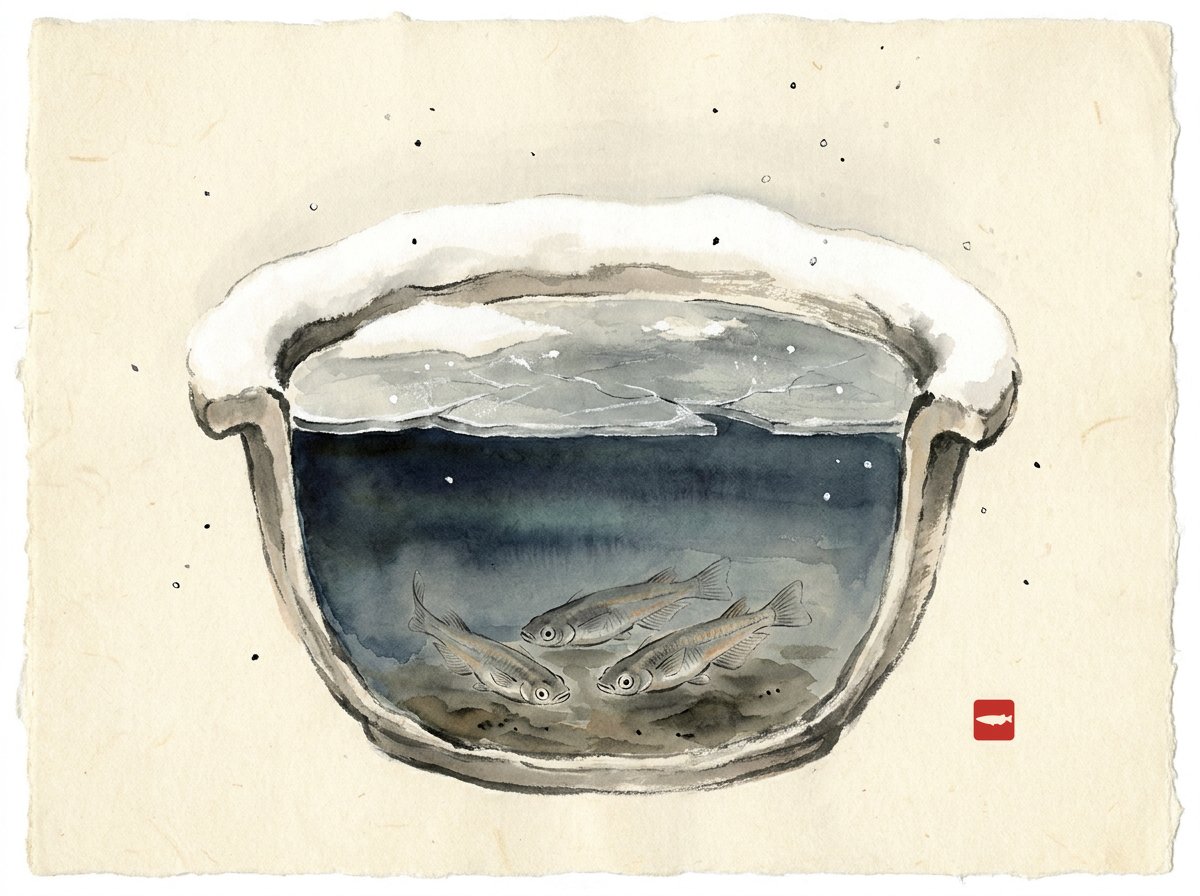
Ice on top, calm underneath. Winter works when the pot is deep enough. My illustration.
The cold end
Cold is the end medaka handle best, and it surprises people. They evolved in Japanese rice paddies, ditches, and ponds that cool and sometimes ice over, so a slow slide into the 40s does not distress them. They eat less and less, settle near the bottom, and wait. That slow, quiet stretch is normal and healthy.
What actually kills is a container freezing through. A large, deep tub holds enough thermal mass to keep liquid water beneath a surface lid of ice, and fish sit it out down there. A shallow container can freeze solid, and nothing survives that.
So the cold-weather question is never "how cold does it get here", it is "how big is my container". My outdoor guide covers depth and overwintering, and the heater guide explains why adding warmth is not the fix.
The hot end, which is the riskier one
Heat is where outdoor keepers actually lose fish, and the reason is not the temperature itself. It is that warm water holds less dissolved oxygen. As a tub climbs through the mid 80s the oxygen available falls at exactly the moment the fishes' metabolism is demanding more of it.
The warning sign is unmistakable: fish gathered at the surface, gulping. That is not them enjoying the sun, it is them working the only oxygen-rich layer left. If you see it, act that day.
Four things help, roughly in order of effect. Shade, whether from floating plants, a shade cloth, or moving the container. Surface agitation from an air stone or sponge filter, which puts oxygen back in. Volume, since a bigger body of water heats more slowly. And less food, because digestion consumes oxygen and decaying leftovers consume more.
What does not help is dumping in cold water, which trades a slow problem for a fast one.
Why the rate of change matters more than the number
This is the part most temperature advice misses. A medaka that has drifted down to 45 degrees over six autumn weeks is fine. The same fish moved from a 72 degree tank into 45 degree water in ten minutes may not be. The fish has not changed; the speed has.
That is why a bigger container is genuinely safer at both ends. Volume buffers change, so the water moves slowly enough for the fish to keep up. A small bowl on a windowsill can swing further in one sunny afternoon than an outdoor stock tank does in a month.
It is also why acclimation matters when moving fish. Float the container, mix the water gradually, and give it an hour. My indoors versus outdoors guide covers moving fish between the two.
Practical rules
Outdoors, go as large and as deep as you can, add floating plant cover before summer, and stop feeding when they stop eating in autumn. Indoors, room temperature is already ideal, so no heater and no chiller, just keep the tank out of direct sun through a window, which can cook a small tank surprisingly fast.
And in a heatwave, watch for surface gulping. It is the earliest reliable signal you will get, and it gives you time to act.
Mine live outdoors year-round, so they arrive already used to water that moves with the weather. Every live order ships with free floating plants, which is the shade that matters most in a summer tub.
Shop Medaka VarietiesCommon questions
What temperature range can medaka survive?
Medaka survive roughly 40 to 85°F when changes are gradual, and they do best and stay most active from the low 60s to the high 70s. They color up best in that range too, and they slow down and eat very little in cold water, resting near the bottom. Sustained temperatures in the 90s are risky, mainly because warm water holds less oxygen and fish need more of it.
How cold can medaka survive?
Very cold, provided the water does not freeze through. In a large, deep container they overwinter beneath a surface layer of ice, resting near the bottom and eating little or nothing. A shallow container that freezes solid will kill them, so container volume and depth matter far more than the air temperature.
How hot is too hot for medaka?
Trouble starts in the mid 80s Fahrenheit and sustained 90s are dangerous. The problem is oxygen rather than heat: warm water holds less of it. Fish gathered at the surface gulping is the warning sign. Shade, surface agitation from an air stone, more water volume, and less food all help.
Do medaka need a heater or a chiller?
Neither. Medaka are temperate fish that expect temperatures to move with the seasons, so a normal room indoors sits inside their comfortable range and an outdoor container is fine year-round if it has enough volume and depth.