About Firefly Medaka
Hi, I'm Chris! I breed Japanese medaka in Raleigh, North Carolina. Seventeen pots on the backyard deck, raised outdoors year-round and shipped across the country.
My son helps, if you want to call it that, and I expect he will play a bigger part as he gets older. The rest of the family provides emotional support.
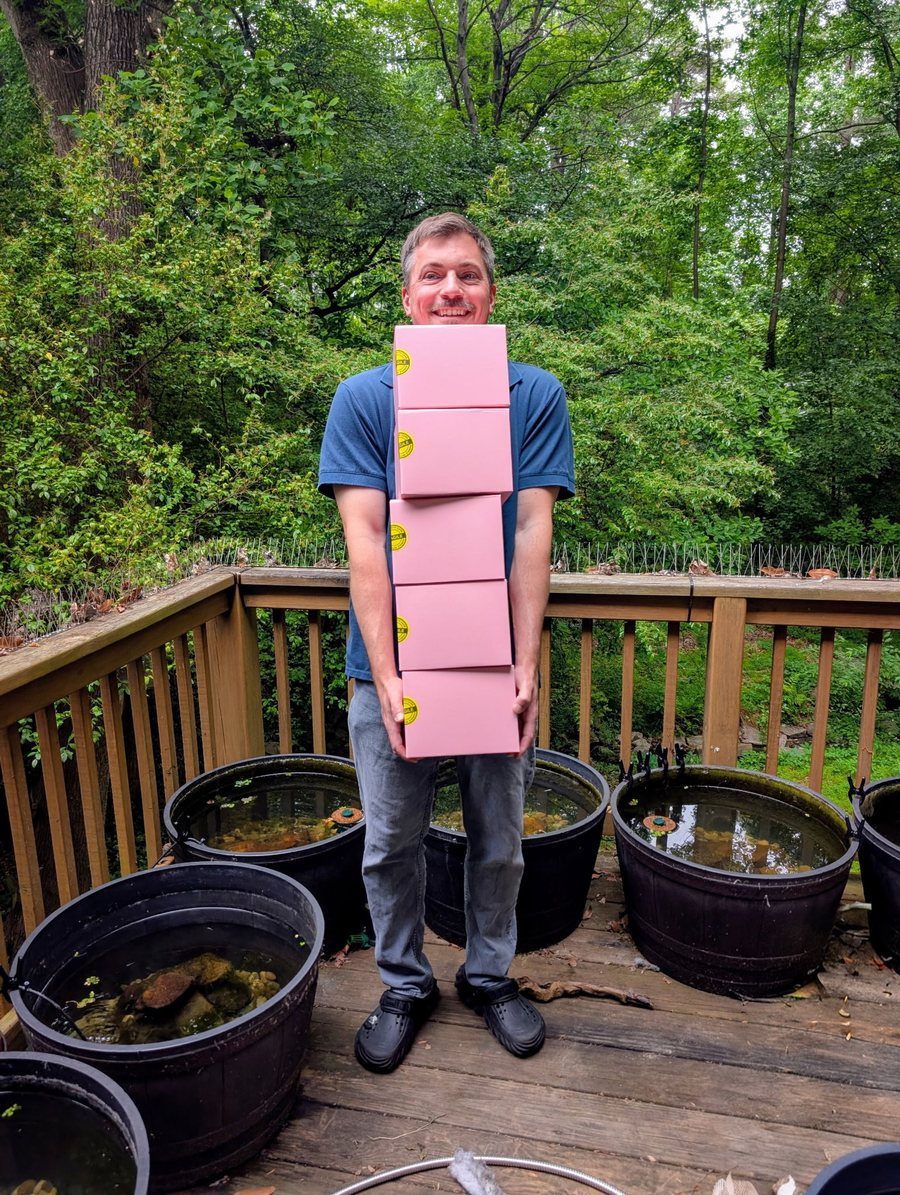
An ordinary shipping day. The pots around me are where every fish I send is raised.
Why medaka, after more than thirty years of fish?
I have kept freshwater fish for more than three decades, and I am genuinely interested in all of them. Medaka are the ones that turned into a passion, and into a desire to share a niche part of the hobby that the big box stores ignore completely.
It started the way a lot of good hobby detours start: nerding out on fish videos on YouTube. The channel was Aquapros, who was getting into medaka around the same time, and this is the video that did it. Shout out for the introduction. I decided to try a few, and the rest has been history.
I have been selling medaka for over two years now. Seventeen pots, two of them currently empty. I had to go outside and count to answer that. So when I tell you this is a small operation, I mean it.
Why Firefly?
Because of what the yard looks like on a Carolina summer night. It took three names to get there, though.
I started on eBay as ECAquatics. The EC stood for East Coast, which felt worth saying out loud, because most medaka breeders seem to be out in California, which makes the most geographical sense in relation to Japan. It was also meant to sound like EZ, since medaka genuinely are easy fish to care for. Serviceable name. Not a memorable one.
Then came Chris Sells Fish, which I still like. It says precisely what goes on here. But the fireflies lighting up these Carolina nights are something else, and that felt like it belonged on the sign more than my own name did. Fireflies also felt regional in the way ECAquatics had been reaching for: you do not think of them and picture California. So I changed it once more, and got the East Coast back into the name without spelling it out. It does not hurt that the Miyuki line I have been breeding for glow does something similar when the light hits it.
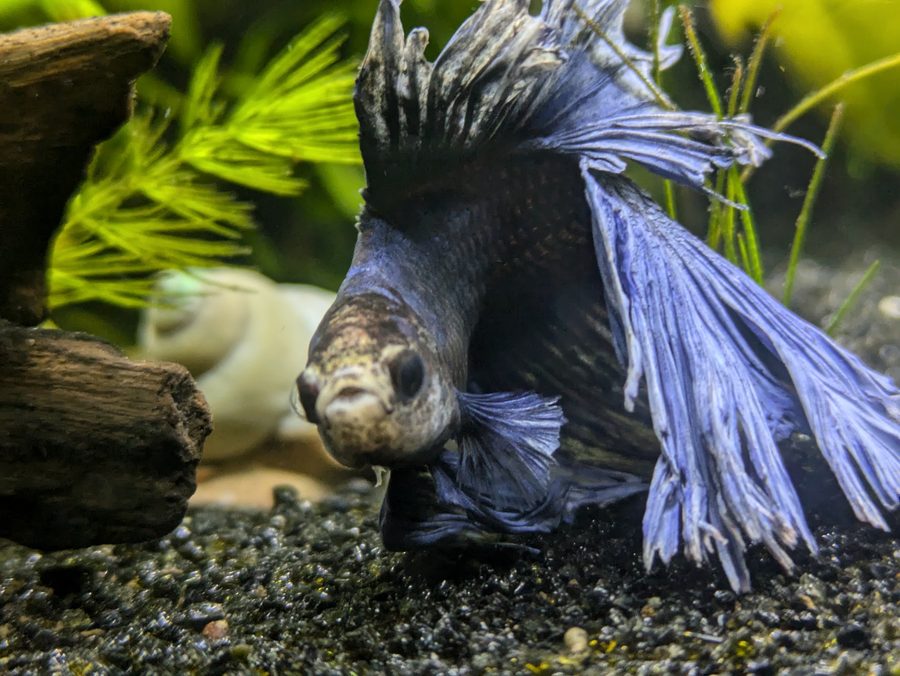
The logo has been evolving right alongside the name. For a long time there was a betta front and center. That was deliberate, an ode to a specific fish: the betta I bought for my oldest daughter, the one who resparked my interest in this hobby after years away from it. Sentimental for me, and completely baffling for anyone else, since there was no way for a customer to know the story. Mostly, though, I did not love the idea of someone landing on a page that says Medaka, seeing a betta, and concluding that I could not tell the two apart. So he retired from public life, though his legacy is honored right here on this page, which feels like the better place for it anyway.
What is up there now is simple and, I think, fun. It used to be a brighter pink. I toned that down, then recently gave the whole thing a polish.

Why is everything here a natural setup?
Because it works better than anything I have bought to replace it, and it costs less. A natural setup is whatever you can do to mimic the fish's native habitat, within reason. Rice paddies, in the case of medaka: still-ish, planted, and full of life. Still-ish because I do run gentle sponge filters, and the fish seem to genuinely enjoy playing in the bubbles.
Within reason is doing some work in that sentence. A real paddy is shallow, and I go deeper than that on purpose. More water is more stable water, and depth is what carries a pot through a Carolina August and a Carolina January without me worrying about it.
Medaka are not big talkers, so I am working from inference here. But I have a hard time believing they are thrilled about a bare plastic container from the hardware store. Bare is not natural, and it is not what I would want to live in either.
The good news is that natural is usually cheaper. Retail stores will happily sell you decorations and rocks that can leach who knows what into your water or scratch a fish that brushes past. Skip all of it. Most of what you need can be sourced outside or reused from your own yard. Do not let the big box stores fool you.
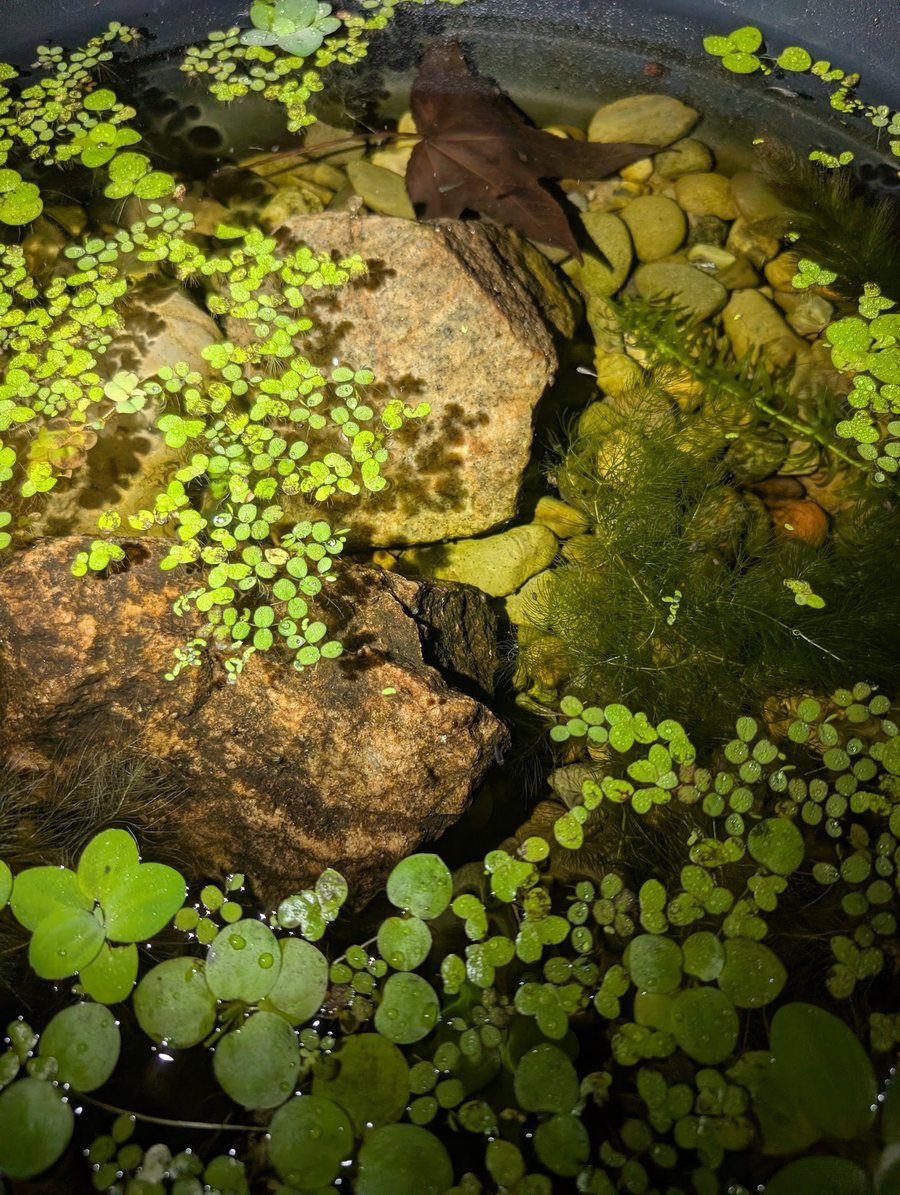
The larger rocks in my pots came out of the creek running behind my house, and they went in straight from the water while still wet. That part is deliberate. Letting them dry out kills the organisms living on them, and those organisms are a big reason I wanted the rocks in the first place. The other reason is cover: my pots live outdoors where predators visit, and a rocky bottom gives the fish somewhere to disappear to. Wet from the creek to the pot gives a brand new container a real head start.
The smaller rocks are less romantic. They came from a decorative rock trail that was already here when we bought the house, almost certainly bought at a big box hardware store, and definitely never intended for an aquarium. That is rather the point. Something does not have to be sold for fish to work for fish, and you are usually paying a premium when it is.
The one thing to be careful about is where the material has been. A rock from ground that gets sprayed with pesticide is not safe no matter how good it looks. You want something organic and undisturbed, which in practice means you know its history. If you do not know, leave it where it is.
People overthink this hobby. It is genuinely simple. I am giving you my two cents here and you can go plenty of other directions with it, this is just what I prefer and what I know works for my fish.
Can you really build a setup for about twenty dollars?
Yes. Not a corner-cutting version either, a genuinely good setup. To be clear, I am not telling you where to shop or that any one store is best. This gets asked a lot, so here is the cheapest acceptable route I know.
Walmart was selling plastic whiskey barrel planters earlier this year for around fifteen dollars. If they still have them, one of those will do the job. Grab a bottle of dechlorinator while you are there, from the fish section. I am old enough to remember when Walmart sold fish.
Check that the bottom is sealed, which is the one thing that actually matters with any planter you repurpose. Get it home, find some rocks, fill it with the hose, add the dechlorinator, and you are basically done.
My one piece of advice on this: buy the biggest one you can afford and have the space for. More water is more forgiving. Temperature swings slower, a feeding mistake dilutes instead of crashing the whole thing, and you have room to add fish later without starting over. If the choice is a bigger container or a nicer one, take the bigger one every time.
Add live plants when you can. They shade the surface, pull nutrients out of the water, and give fry somewhere to hide. I include some free with every live order, so that part is covered if you buy from me. My outdoor pond guide goes further if you want it.
Do the different colors have different personalities?
I do not see much difference in temperament between the color lines. The exception may be the Orochi, who seem more aggressive with bugs that wander into their setup. Then again, maybe I am seeing things.
I value all of my fish equally and I see the beauty in every one of them. What I will admit is that photographs do not do them justice, and photography is the part of this site that needs the most work. It is coming. I promise.
If I had to name a favorite line, it would be the Miyuki. They were the first medaka I ever bought, and I have been selectively breeding them since to bring out fuller glows, the kind you can see lit up when you look down on the pots from an upstairs window. They happen to be one of my best sellers too, so I am not alone on that one.
I am not rushing to add every variety under the sun. People tend to have their preferred types, so for now I would rather do a handful properly. Keeping the numbers smaller is not only about focus, either. It means I can actually look at every fish I raise rather than working from a sample, and I screen them again before anything is packed for shipping. I would rather catch something myself than have you find it. The goal is that you end up as attached to these fish as I am. Never say never on new lines, though.
What are you breeding for?
Some breeders work to preserve named lines exactly as tradition defines them. That is a real craft, and I respect the effort it takes. It is also not what I am doing. I breed for healthy fish, beautiful color, and the plain joy of watching them, and I measure success by whether you and your fish are both still happy a year after the box arrives.
My take is that all of my fish have value, no matter the color, and no matter whether they landed on a line's look or not. It is why the Breeder's Choice Collection exists instead of a cull bucket. And you will not find awards or memberships here, now or later. The only judging table I care about is your deck, and whether the fish on it are thriving. The operational version of all of this is written down on The Firefly Standard.
What is the hard part of doing this outdoors?
Everything outdoors comes with outdoor consequences. I have had a run of flash floods this year, which means leaving whatever I am doing and going out in the storm to start draining pots before they overflow. Dragonfly nymphs turn up and have to be removed. Raccoons would very much like to eat my snails, and earlier this year one of them got into a container of medaka food I had left outside and helped itself. Not a disaster on its own, but these things add up. It is a constant battle.
Things also wear out faster out here. Sun, freeze, thaw, and rain work on plastic all year. Look at the photo at the top of this page: the pot beside my right foot has a leak. It is out of commission now. The pot itself is cheap enough, but draining it, moving the fish, and setting the replacement back up is an afternoon you did not plan on. That is the part of outdoor keeping nobody puts in the brochure.
I will also tell you that I genuinely dislike shipping fish. It is one of those "it is what it is" parts of the job, and since it has to happen, I do what I can to make the trip as easy on them as possible. I typically ship UPS to keep transit inside a two day window. Every seller does this differently, which I find genuinely interesting, and I am still refining mine.
If a beginner asks me the single most common mistake, it is overfeeding, every time. My feeding guide covers what that looks like.
Why sell here instead of eBay?
Mostly because the fees there come out of the fish. I have sold on eBay for a while, and that page is still running. The customer reviews on the homepage come from there, which is why they say verified eBay purchase. The trouble is that eBay takes a large cut and has some rules I find odd, so it made sense to build somewhere of my own while keeping that page open. I also have an Etsy shop, though that one is spawning mops only, since live fish cannot be sold there.
I happen to have a strong interest in web design, which is how this site ended up being where I would rather sell. Buying direct here means more of what you pay goes into the fish rather than into fees. I may look at other marketplaces eventually, but I am content with this.
That interest turned into a second thing I do: Butterfly Effect Digital, where I build sites for other small businesses. Yes, I built this one, so you have already seen a sample of my portfolio. If you could use a site for whatever reason, come say hi. I will try to keep the fish talk to a minimum, though I make no promises.
Let's chat!
When you email Firefly Medaka, you are emailing me. I answer everything myself, and I genuinely enjoy it when customers want to talk fish. Fair warning: I probably talk too much. If I start nerding out, feel free to tell me to shut up.
If something goes wrong with an order, tell me and I will sort it out. What I will not do is quote policy at you. I have been on the receiving end of that as a customer and it is a miserable experience. There is a policies page because a store needs one, and I could not recite it to you from memory if you asked. I would rather just fix your problem.
Every live order is covered by my live arrival guarantee, and I hold shipments when the weather makes travel unsafe, even when that means waiting a week.
Send me a message, whether you have ordered from me or not. Questions about a setup you are planning are just as welcome as questions about an order.
Come see what I am raising
Outdoor-raised medaka, freshwater snails, live plants, and handmade spawning mops, shipped from seventeen pots in North Carolina.
Shop Medaka Varieties