What Does Medaka Mean?
Every fish in my pots carries a small piece of Japanese history in its name. Medaka is not a brand or a breeder's invention, it is a word Japanese children have been saying for centuries, and the story packed inside it, high eyes, rice fields, thousands of local nicknames, and a song the whole country knows, is worth five minutes of your time.
High eyes
In Japanese, medaka is written with the kanji 目高: 目 is eye, 高 is high. High eyes. Look at one of these fish from the side and the name explains itself, the large eyes sit unusually high on the head, angled upward. That is no accident of styling. Medaka are surface fish, they live, feed, and spawn in the top inch of water, and eyes set high are exactly the tool for a life spent watching the surface for food and the sky for danger. It is also why they are so rewarding in a pot: those upturned eyes are what meet yours when you look down. Modern Japanese usually writes the name in kana, めだか or メダカ, but the old kanji is the meaning.
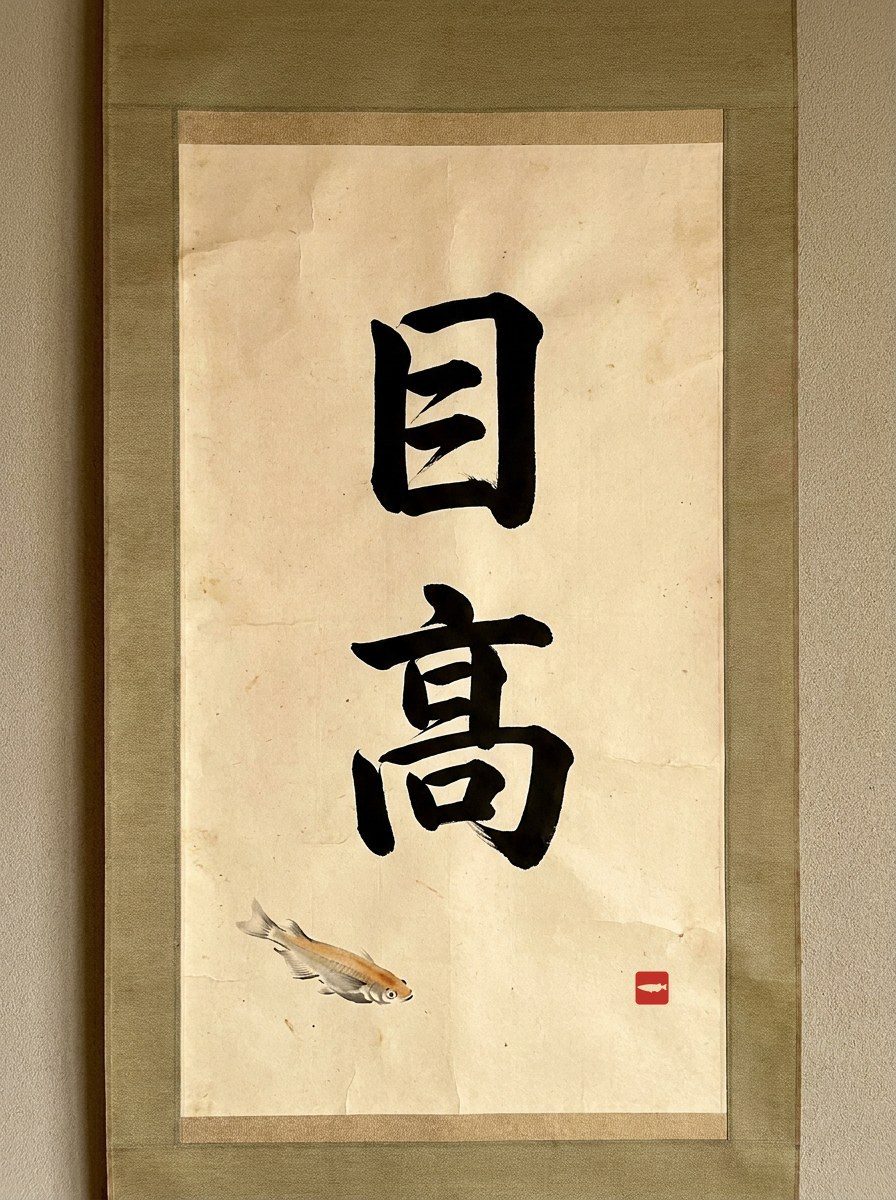
目高, high eyes, in the traditional vertical hand. My illustration, in the style of a hanging scroll.
The rice fish, officially
The scientific name says the rest. Oryzias latipes: Oryzias comes from Oryza, the botanical genus of rice, because this is the little fish of the flooded rice paddy, and latipes is Latin for broad-footed. So the formal name essentially says rice fish, which is exactly what English calls them: Japanese rice fish. For centuries the flooded paddies, ditches, and slow streams of rural Japan were full of them, which is how a fish barely longer than a thumbnail became one of the most familiar animals in the country. My what are medaka guide covers the fish itself.
A fish with 4,600 names
Here is my favorite measure of how deeply this fish sits in Japanese life: a linguistic survey recorded over 4,600 local and dialect names for medaka, gathered from communities across Japan, Korea, and Taiwan. Not 4,600 varieties, 4,600 words, village by village, for the same little fish. An animal only collects that many nicknames by being part of everyone's childhood, everywhere, for a very long time. Most of those names are fading now that schoolbooks use the standard one, but the number remains a kind of fossil record of affection.
From the Edo period to your patio
Keeping medaka for pleasure is old. By the Edo period (1603 to 1868), the era of samurai, woodblock prints, and goldfish peddlers, the orange variant called himedaka was already known and kept, centuries before anyone owned an aquarium heater. The modern era added the explosion of named varieties, hundreds of lines bred for shine, color, and pattern in the last few decades, which is the world my varieties guide maps. The names of those lines are Japanese history too: on my product pages, the little flag button opens the story behind each fish's name.
The song every Japanese child knows
In the years just after the war, a Japanese lyricist named Shigeru Chaki was living near Odawara when, as the story goes, he and his young son spotted medaka in a stream and the boy declared it their school. In 1950 Chaki turned that memory into a lyric, and the children's song that came from it, Medaka no Gakkō (The Medaka School), with music by Yoshinao Nakada, was first broadcast on NHK radio in 1951 and simply never left. Generations of Japanese children have sung about the medaka school in the stream, where you should peek quietly to see who the teacher is. In 2006 it was chosen for Japan's list of 100 beloved songs, announced in January 2007. When you watch a group schooling in a tub, you are looking at the exact scene the song describes.
The plot twist
The fish with 4,600 names is now rare where it started. As paddies were consolidated and waterways lined with concrete, wild medaka declined so sharply that Japan placed them on its national Red List of threatened species in the late 1990s, national news for a fish everyone thought of as common as sparrows. Science later complicated the picture further: in the 2010s the northern wild populations were described as a separate species, Oryzias sakaizumii. The medaka in the hobby, mine included, are captive-bred lines many generations from the wild, so keeping them puts no pressure on wild fish. If anything it does the opposite, every pot on a patio keeps the fish, and the word, alive somewhere new.
Every named line I sell has its story on the product page, tap the flag button to read what the Japanese name means and where it came from.
See the Fish LinesCommon questions
What does the word medaka mean in Japanese?
Medaka is written with the kanji 目高, literally high eyes, because the fish's large eyes sit unusually high on its head. It is a surface fish, and those upturned eyes are exactly what you notice looking down into a pot. Modern Japanese usually writes the name in kana as メダカ.
What does Oryzias latipes mean?
Oryzias comes from Oryza, the botanical genus of rice, because the fish historically lived in flooded rice paddies. Latipes is Latin for broad-footed. Put together, the scientific name essentially says rice fish, which is why the English common name is Japanese rice fish.
How long have medaka been kept in Japan?
Medaka have been part of daily Japanese life for centuries, and keeping them ornamentally goes back to at least the Edo period (1603 to 1868), when the orange himedaka variant was already known. The modern breeding boom that produced today's hundreds of named varieties took off in the last few decades.
Are medaka endangered in the wild?
Wild medaka populations in Japan declined enough that the fish was added to Japan's national Red List of threatened species in the late 1990s, largely from habitat loss as rice paddies and waterways were modernized. The fish in the hobby are captive-bred, so keeping them puts no pressure on wild populations.