What Are Medaka?
Medaka are Japanese rice fish, Oryzias latipes, a small freshwater fish native to the rice paddies, ditches, and slow streams of Japan. They have been kept as ornamental fish there for centuries, and they are one of the few fish that will live outdoors, unheated, through a real winter.
The short version
An adult medaka is about an inch and a half long. They live near the surface in loose groups, they are peaceful to the point of being defenceless, and they tolerate a temperature range that would kill most aquarium fish. The name comes from the Japanese medaka, a reference to their prominent, high-set eyes.
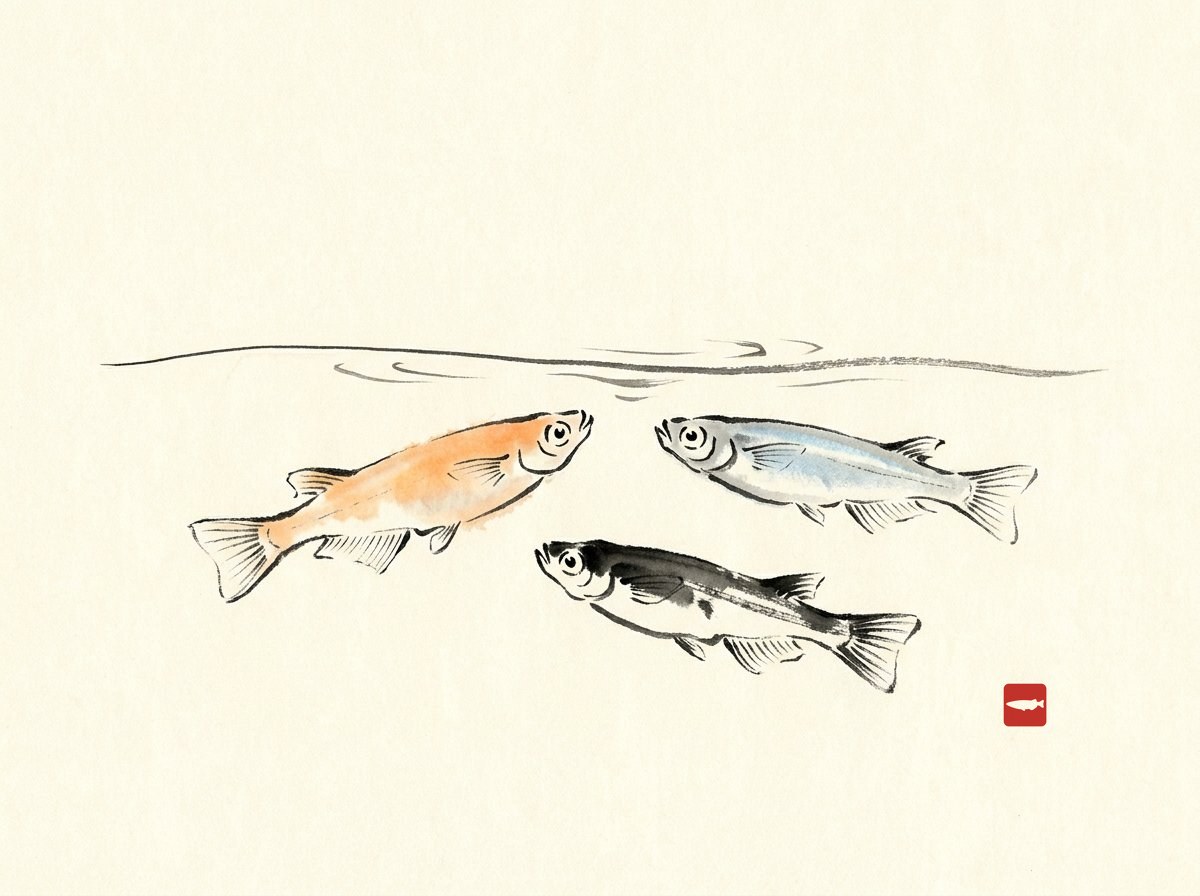
High eyes, upturned mouths, built for the surface. My illustration.
They are sometimes called Japanese rice fish, which is the more literal description: these are the fish that historically lived in flooded rice fields, eating insect larvae and whatever the water produced.
Why the rice paddy matters
Almost everything that makes medaka easy to keep traces back to where they come from. A rice paddy is shallow, still, warm in summer, cold in winter, and biologically rich. A fish that thrives there has to tolerate a wide temperature swing, cope with low oxygen, feed at the surface, and breed fast during a short good season.
That is a precise description of a medaka, and it is why they suit a patio tub so unusually well. A container of still water in your backyard is close to their native habitat, which is not something you can say about most fish in a shop.
What makes them different from other small fish
They are temperate, not tropical. This is the big one. Guppies, tetras, and most small colorful fish need heated water. Medaka survive roughly 40 to 85°F when changes are gradual, do best from the low 60s to the high 70s, and expect the seasons to move. No heater, ever.
They are egg scatterers with a twist. Females carry a cluster of eggs attached beneath the body for a while after spawning, then wipe them onto plants. You can often see the eggs on the fish, which is unusual and genuinely lovely to watch.
They come in remarkable colors. Japanese keepers have selected medaka for centuries, and the last twenty years of breeding there produced lines with metallic sheens, blue and platinum bodies, and even light-reflecting scales. My fish varieties page shows what that looks like in practice.
A quick note on the science
Oryzias latipes is also a long-established model organism in genetics and developmental biology, studied in laboratories since the early twentieth century. That is not a reason to keep them, but it does explain why the species is unusually well documented, and why they have turned up in spaceflight research.
Who they suit
Medaka are a strong fit if you want an outdoor container pond, if you would rather not run a heater, if you want mosquitoes gone from a water feature, or if you want a fish that will breed for you without much intervention. They are also an excellent first fish, because the main ways beginners lose fish, temperature swings and inconsistent conditions, are exactly what medaka shrug off.
They are a poor fit if you want a large centerpiece fish, or a fish that interacts with you like a goldfish or koi does. Medaka are a fish you watch as a group, not one you name.
If that sounds right, my complete care guide covers setting up from scratch, and how they compare to goldfish, koi, and guppies is worth reading if you are still deciding.
Japan's long tradition of keeping and breeding medaka, raised here through real seasons in planted, natural setups. Every live order ships with free floating plants and my live arrival guarantee.
Shop Medaka VarietiesCommon questions
What are medaka fish?
Medaka are Japanese rice fish, Oryzias latipes, a small freshwater fish about an inch and a half long, native to rice paddies and slow waters of Japan. They have been kept ornamentally in Japan for centuries and are notable for tolerating cold that most aquarium fish cannot.
Are medaka and Japanese rice fish the same thing?
Yes. Medaka is the Japanese name and Japanese rice fish is the English description of the same species, Oryzias latipes, named for the flooded rice fields they historically inhabited.
Are medaka good for beginners?
Yes. They need no heater, often no filter, tolerate a wide temperature range, and breed readily. The conditions that cause most beginner fish losses, temperature swings and imperfect stability, are exactly what medaka are built to handle.
How big do medaka get?
Adult medaka reach roughly 1.2 to 1.6 inches, or 3 to 4 centimeters. They stay small their entire lives, which is why they suit patio tubs and small containers that would be badly overstocked by goldfish or koi.