Normal, Hikari, and Daruma
These are body types, not colours. It is the single most common point of confusion for people new to medaka. A colour line like Miyuki or Orochi tells you about pigment. Normal, Hikari, and Daruma tell you about the shape of the fish and its fins, and the two are completely independent of each other.
Normal
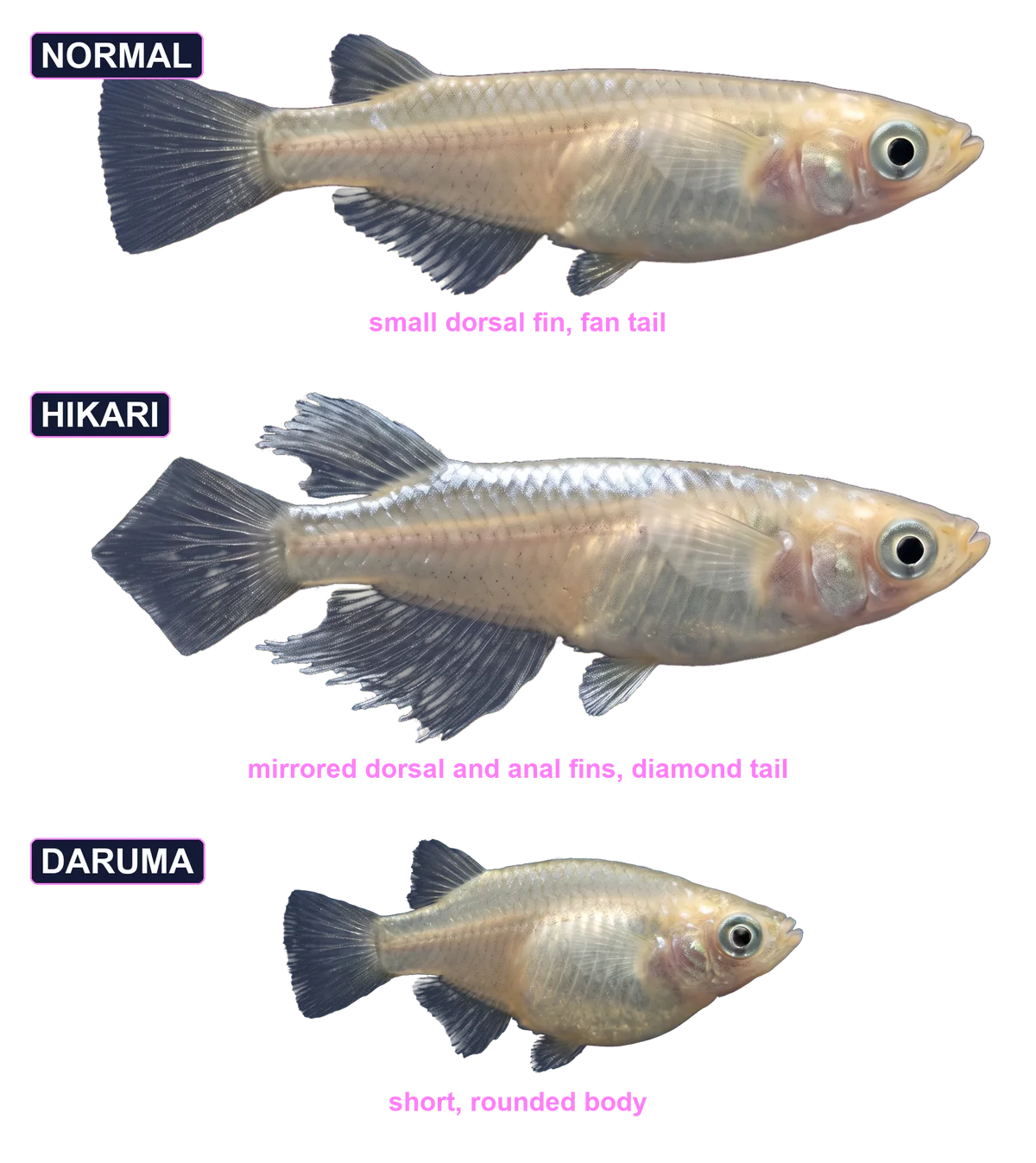
The standard, wild-type shape, and the one nearly every medaka you meet will be. A small dorsal fin set well back on the body, a fan-shaped tail, and a straight, streamlined profile. If a fish is not described as anything in particular, it is Normal.
This is also the toughest of the three. Nothing about the body has been altered from what the fish evolved with, so Normal-bodied medaka are the easiest to keep, the easiest to breed, and the right starting point for anyone new to the species.
Hikari
Hikari means light, or shine. The giveaway is the dorsal fin: on a Hikari it is shaped like the anal fin underneath, long and low rather than small and rounded. That makes the fish look mirrored top to bottom, and once you have seen it you cannot unsee it. The tail is diamond or rhomboid rather than fan-shaped, and many Hikari carry a metallic sheen along the back, which is where the name comes from.
Hikari are not difficult fish. Care is essentially the same as Normal. What you are buying is a different silhouette, and it is one that reads especially well viewed from above, which is how most people actually look at an outdoor container.
Daruma
Named after the round Daruma dolls, and for the obvious reason. A Daruma has a shortened body, compressed front to back, so the fish is stubby and round instead of streamlined. A half-Daruma sits between the two: shorter than standard, but not as extreme.
Now for where I stand, because I get asked. That shortening packs everything inside the fish into less room, and keepers widely report that Daruma are prone to buoyancy and swimming trouble. Careful keeping helps, but it does not change the body type. I do not breed or sell Daruma, and I do not think anyone should. A fish that struggles to swim should not be bred on purpose, however charming the round shape is. You will see them for sale elsewhere, and that is your call to make. I would rather you at least know what the shape costs the fish before you decide.
How to tell them apart, quickly
| Type | Dorsal fin | Tail | Body | Health |
|---|---|---|---|---|
| Normal | Small, set back | Fan-shaped | Streamlined | Robust, the hardy default |
| Hikari | Long, mirrors the anal fin | Diamond | Streamlined | Robust, same as Normal |
| Daruma | Normal | Normal | Short and round | Compromised: prone to lifelong buoyancy and swimming problems |
The fastest check is the dorsal fin. Look at the fish from the side: if the fin on top looks like a match for the fin underneath, it is Hikari. Then look at the length of the body: if it is short and round, it is Daruma. Everything else is Normal.
Body type and colour are separate
Because the two are independent, a colour line can appear in any body type, and Japanese breeders name fish by combining the two. That is why medaka names get long. Once you know that the colour part and the shape part are two different pieces of information, the names stop being intimidating.
All of my lines are Normal-bodied and described by colour on their listings. If you are ever unsure what you are looking at, just ask.
Outdoor-raised in North Carolina through real seasons, all Normal-bodied. Browse by colour, and ask me if you are after a particular body type. Every live order ships with free floating plants and my live arrival guarantee.
Shop Medaka VarietiesCommon questions
What is the difference between Normal, Hikari, and Daruma medaka?
They are body types rather than colours. Normal is the standard wild-type shape, with a small dorsal fin set back on the body and a fan-shaped tail. Hikari has a dorsal fin shaped like its anal fin, so the fish looks mirrored top to bottom, and a diamond-shaped tail. Daruma has a shortened, rounder body. Any colour line can occur in any body type.
What does Hikari mean in medaka?
Hikari means light or shine in Japanese. The Hikari body type is recognised by a dorsal fin shaped like the anal fin, giving a symmetrical top-to-bottom outline, and a diamond or rhomboid tail rather than a fan. Many Hikari also carry a metallic sheen along the back, which is where the name comes from.
Are Daruma medaka harder to keep?
Often, yes, and good care does not fully remove it. The shortened body packs everything inside into less room, and keepers widely report that Daruma are prone to buoyancy and swimming problems. I do not breed or sell Daruma for that reason: I believe a fish should not be deliberately bred into a body that makes swimming a struggle.
Is body type the same as colour in medaka?
No, and this is the most common confusion. Colour lines such as Miyuki or Orochi describe pigment and pattern. Body types describe the shape of the fish and its fins. The two are independent, so a single colour line can appear as Normal, Hikari, or Daruma.
What is a half-Daruma medaka?
A half-Daruma is intermediate between a Normal body and a full Daruma, shorter than standard but not as compressed. They are often reported to be hardier than full Daruma while still showing the rounder shape.