Medaka Lifespan and Life Stages
Medaka commonly live about two years in a home setup, and three or more with good care, and pack a surprising amount into that. They can go from egg to breeding adult inside a single warm season, which is why a spring purchase often means babies before autumn.
The stages, roughly
Timings below assume warm conditions. Everything slows in cooler water, and outdoors the whole calendar shifts with the season, so treat these as a sequence rather than a schedule.
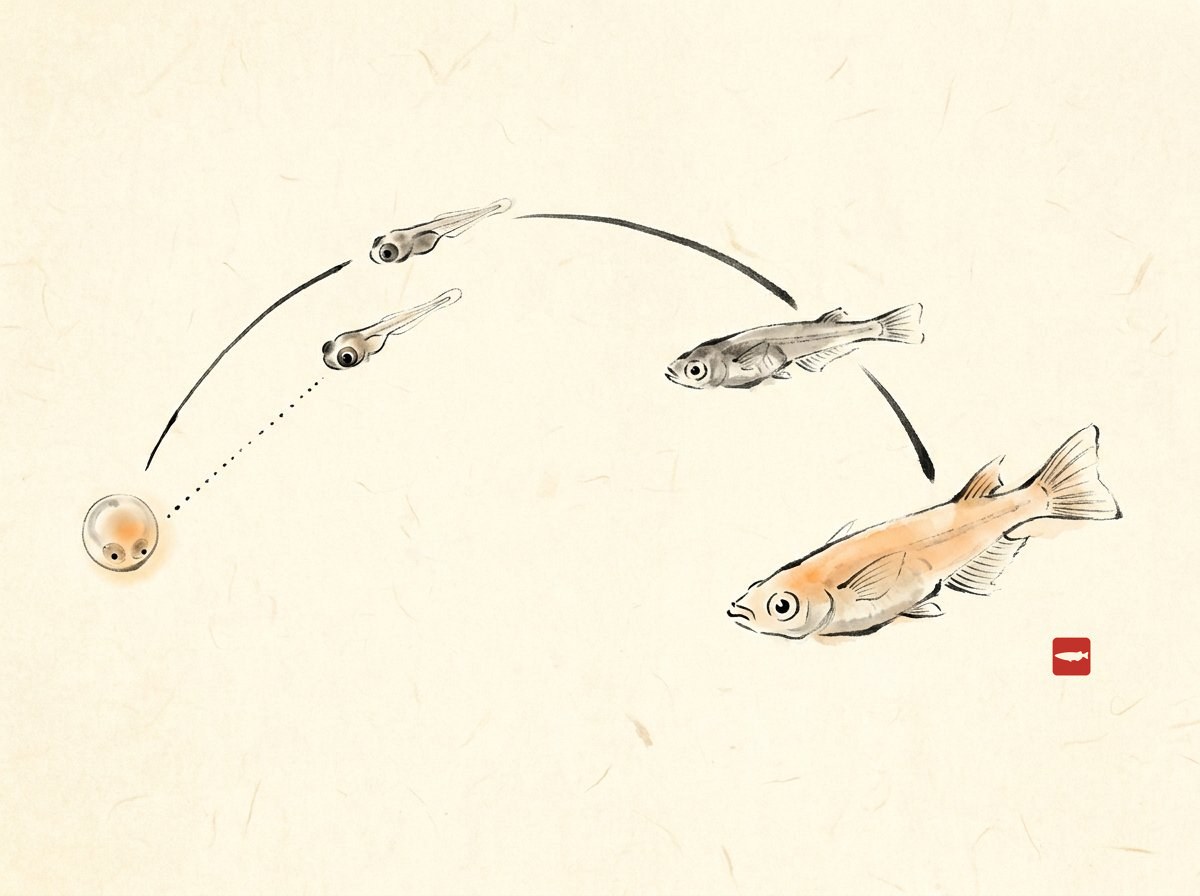
Egg to fry to adult, the whole arc. My illustration.
| Stage | Roughly when | What you see |
|---|---|---|
| Egg | 9 to 11 days at mid-70s F | Clear sphere, eyes visible before hatching |
| Newly hatched | First week | Barely visible, stays near the surface |
| Fry | Weeks 1 to 4 | Grows fast, still too small for adults |
| Juvenile | 1 to 3 months | Miniature adult, color starting to show |
| Breeding adult | From roughly 3 months | Full color, sexes clearly distinguishable |
| Mature adult | Year 1 to 2 | Peak color and heaviest laying |
| Older fish | Year 2 onward | Laying tapers, color may soften |
Cool water stretches every one of these. A fry hatched in late summer will grow far more slowly than one hatched in June.
Egg to fry
A fertilized egg is a tough little sphere you can move by hand, which is what makes this species so rewarding to breed. Development runs on accumulated warmth rather than a fixed number of days, so hatching takes longer in cooler water. Toward the end you can see eyes through the shell.
Newly hatched fry are close to invisible and extremely vulnerable, both to being eaten and to being offered food too large to fit in their mouths. That first fortnight is where nearly all losses happen, and my fry care guide is entirely about getting through it.
Juvenile: the interesting part
Somewhere in the first couple of months a medaka stops looking like a generic small fish and starts looking like its line. Color and pattern develop gradually rather than arriving at once, which is worth knowing if you buy young fish and wonder why they are plainer than the photos.
This is also when they become safe with adults. The rule is simple: once a young fish is too large to fit in an adult's mouth, usually somewhere around three quarters of an inch to an inch, it can join the main group.
Adult: peak, then plateau
Medaka reach breeding age fast, often within a few months in warm conditions, so a fish hatched in early summer can spawn before its first winter if the days are still long. Through the first year or two they are at their best: fullest color, heaviest laying, most active.
Laying then tapers with age. If you have an older group that bred well for seasons and has slowed down, that may simply be age rather than a problem, though it is worth ruling out the usual causes first with my troubleshooting guide.
What shortens a medaka's life
Very little of it is disease. The common causes are a container too small to buffer change, so temperature and water quality swing sharply; overfeeding, which fouls water faster than anything else; and a shallow outdoor container in winter that freezes through. All three are setup problems, not health problems.
The flip side is that the same seasonal swing people worry about seems to suit them. A fish that cools down and rests in winter is living the pattern it evolved for, which is part of why I keep mine outdoors year-round rather than holding them at a flat temperature.
Planning around it
Two things follow from a two to three year lifespan. First, if you want a group to persist, let some fry survive each season rather than removing every egg, or keep a separate grow-out container. A medaka tub is a rolling population, not a fixed set of fish.
Second, buying a mixed-age group beats buying all adults at once, since an all-adult group ages out together. My breeding guide covers keeping a line going, and stocking covers leaving room for the next generation.
A group bought this season can be producing its own fry within months. Mine are raised outdoors through real seasons, and every live order ships with the free floating plants that give eggs somewhere to land.
Shop Medaka VarietiesCommon questions
How long do medaka live?
Usually about two years in a home setup, and three or more with good care. They reach breeding age quickly, often within a few months in warm conditions, so a fish hatched in early summer can spawn before its first winter if the days are still long.
How fast do medaka grow?
Quickly in warm water. Eggs hatch in roughly 9 to 11 days in the mid-70s Fahrenheit, fry grow through the first month, and juveniles look like miniature adults by one to three months. Everything slows in cooler water, so late-season fry grow far more slowly.
When do baby medaka get their color?
Gradually through the juvenile stage, over roughly the first couple of months, rather than all at once. Young fish often look plainer than adult photos of the same line, and fill in as they mature.
What shortens a medaka's lifespan?
Usually setup rather than disease: a container too small to buffer temperature and water quality swings, overfeeding, which fouls water quickly, and a shallow outdoor container that can freeze through in winter.