Breeding Medaka with Spawning Mops
Medaka are one of the most rewarding egg-layers in the hobby: a healthy female can lay eggs nearly every morning through the warm season, the eggs are tough enough to handle with your fingers, and the fry are simple to raise. Here's my complete process.
What triggers spawning
Two things: day length and temperature. Medaka spawn when days run 13+ hours of light and water holds above roughly 68°F. Outdoors that means late spring through early fall. Indoors you can breed them year-round under a light on a 14-hour timer.
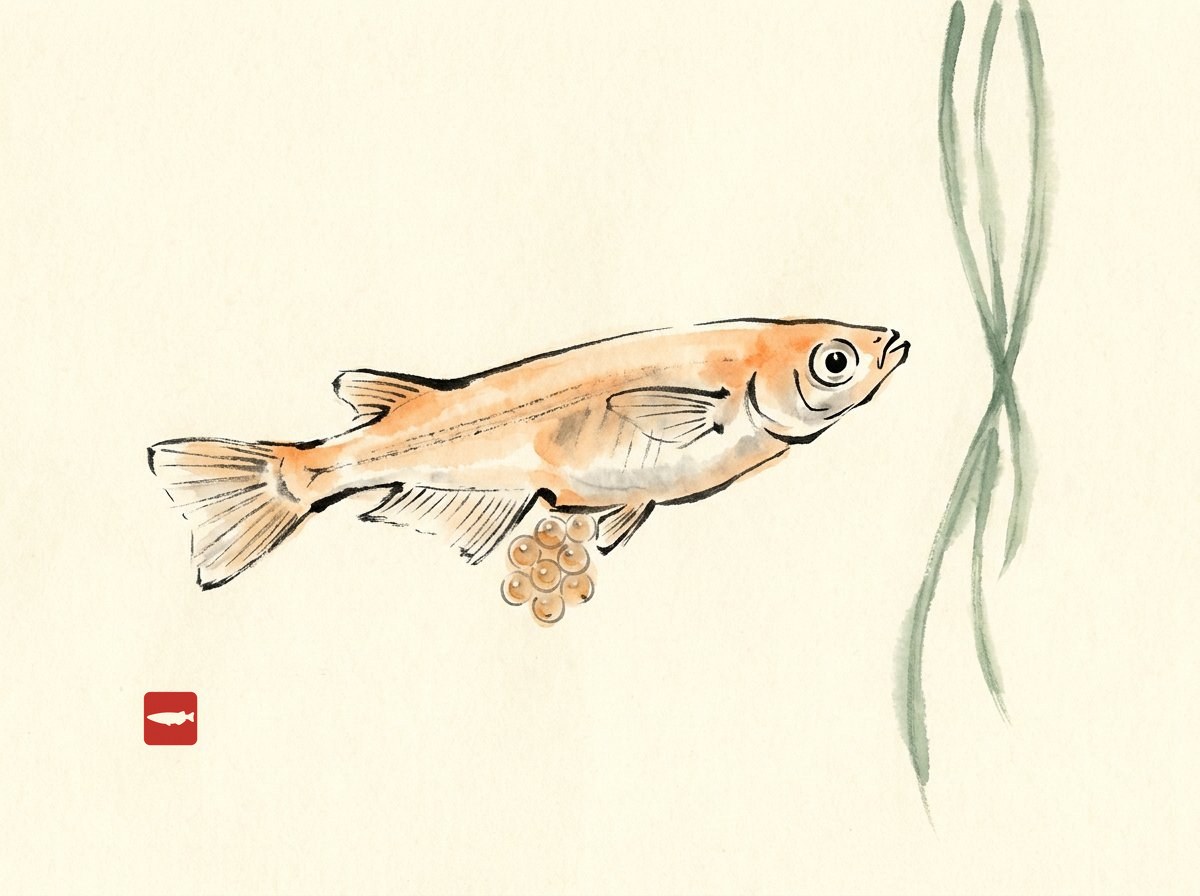
A female carrying the morning’s eggs to the mop. My illustration.
Condition the group for a couple of weeks with rich food, live or frozen daphnia, baby brine shrimp, microworms, and females respond with visibly rounder bellies and daily egg clutches. Once they start, they do not stop!
Telling males from females
- Males have a larger, more angular dorsal and anal fin, often with a slight notch at the rear edge of the dorsal.
- Females have rounder finnage and a fuller body, and you'll see them carrying a cluster of eggs at the vent in the morning during the season.
A ratio of one male to two or three females spreads attention and keeps females from being harassed. My trios ship as a male with two females for exactly this reason.
How medaka spawn (and why mops work)
Spawning happens at first light. The female then carries the fertilized eggs, a grape-like cluster attached at her vent, for a few hours before wiping them onto fine-textured plants near the surface. That wiping instinct is what a spawning mop exploits: a bundle of soft yarn strands reads as the perfect egg-deposit site, keeps eggs in one harvestable place, and can be lifted out without disturbing the tub.
You can also collect eggs directly from females (gently, with wet fingers, hours after spawning) or harvest from floating plant roots, but a mop is the least invasive and most reliable collection method I've used, which is why I make my own.
Hatching the eggs
- Pull the mop (or pick eggs) every day or two. Healthy fertile eggs are clear, slightly amber, and firm enough to roll gently between your fingers without collapsing.
- Cull the bad eggs daily. Any egg that turns white, opaque, or grows a fuzzy halo is infertile or has gone moldy. Pull those out as soon as you spot them, because the fungus spreads to healthy eggs sitting next to them and can take out a whole batch. This one habit matters more than any additive.
- Incubate in a small container of clean water, and keep changing it. Many breeders add a drop of methylene blue or a bit of tannin (an almond leaf) to suppress fungus.
- Warm the water to speed things up. Eggs are at their most vulnerable during incubation, so shortening that window helps. A small adjustable heater held around 78–82°F reliably speeds development; I would not push past the mid-80s, since hotter water raises deformity and die-off rates rather than helping.
- Wait on temperature: medaka eggs take about 10 days at 77°F and about 9 days at 82°F, and longer in cooler water. Eyes appear within a few days; hatch is near when you can see the fry coiled and flicking inside.
Raising fry
- First foods: commercial fry powder, green water, or infusoria for the first week; then baby brine shrimp and microworms as they grow.
- Shallow, still, planted water, a few inches deep with floating plant roots is ideal. No filter, or a gentle sponge only.
- Sort by size. Medaka fry grow unevenly and larger siblings will eat smaller ones. Split them every few weeks.
- Timeline: fry reach sexable size around 8–10 weeks warm, and full color over 3–4 months. Fish hatched in early summer often spawn before their first winter.
Breeding for color: keep lines separate
All medaka varieties are one species and interbreed freely. Crosses are usually drab, the ornamental lines are the result of generations of selection. If you want your Orochi midnight black or your Red King sparkling, keep one variety per container, and select your best-colored adults as next year's breeders. One tub per line is exactly how my ponds are organized.
I hand-make my mops from soft, fish-safe yarn, the same ones working in my own breeding tubs. Pair one with a trio and you have a complete breeding setup.
Get a Spawning Mop