How to Sex Medaka
Short answer: read the anal fin. Colour will not tell you, and size is unreliable, but the fin on the underside of the fish answers the question at a glance once you know the two shapes. Here is what to look for, plus the secondary clues and when each one can be trusted.
The one check that settles it: the anal fin
Ignore colour, ignore size, and look at one place: the anal fin, the fin on the underside of the fish between the belly and the tail. On a male it is long and roughly parallelogram-shaped, with edges that run nearly parallel and corners that look squared off. On a female it is clearly shorter and triangular, widest where it meets the body and tapering toward a point.
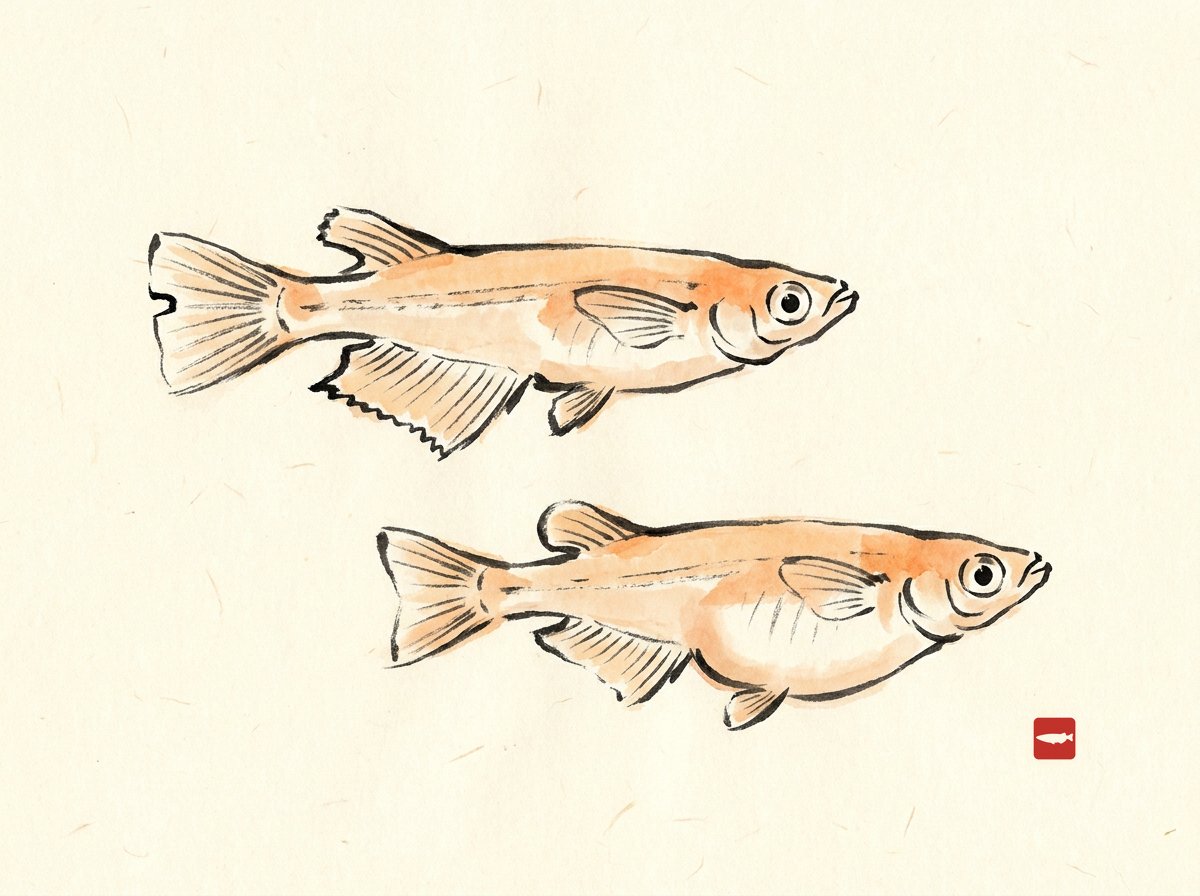
Male above: notched dorsal, big squared-off anal fin. Female below: rounder body, softer fins. My illustration.
The dorsal fin, on the back, gives you a second opinion. A male's is larger, and its back edge carries a small split or notch. A female's is smaller and rounded, with no notch.
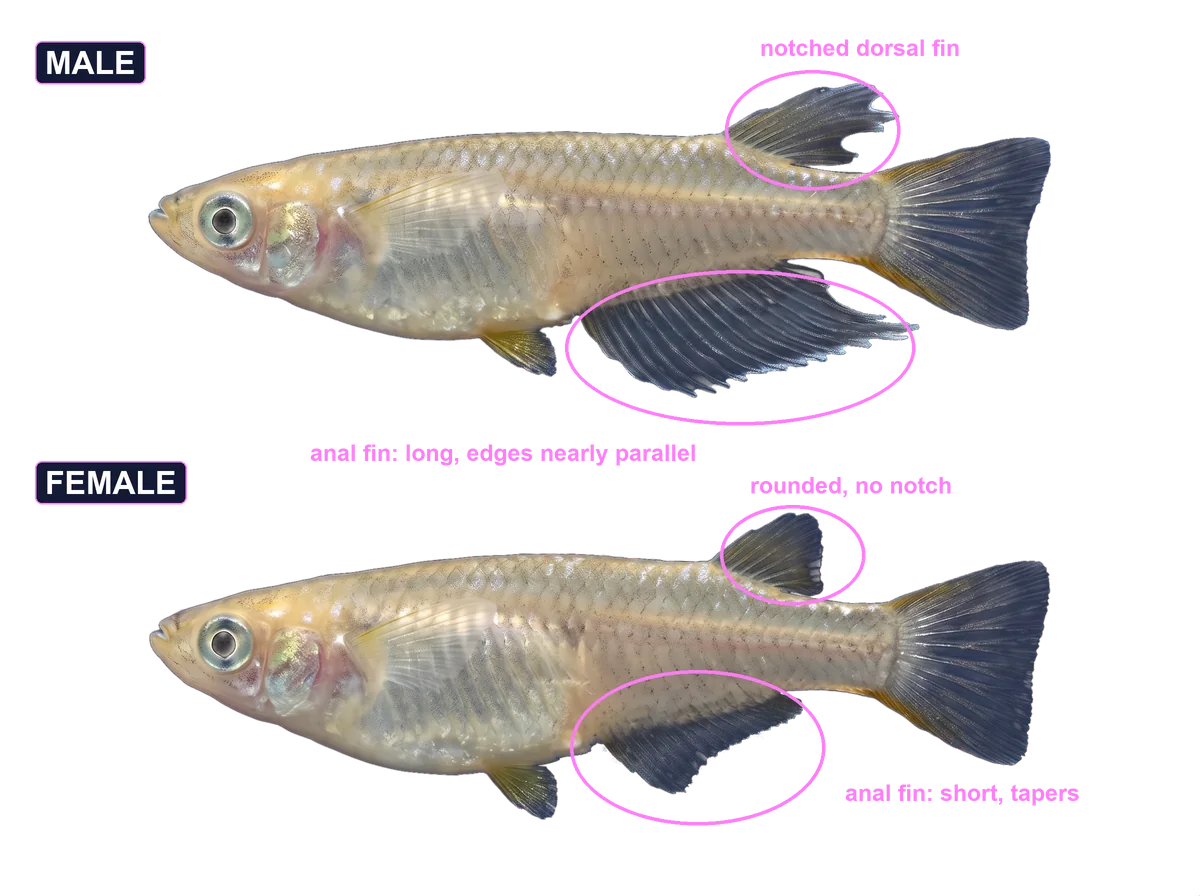
Fins beat every other method because they do not depend on the condition of the fish. A skinny female still has a triangular anal fin. A plump, well-fed male still has a squared one. Body shape changes with feeding and season, but fin shape does not.
The clues that only sometimes help
Body shape. A female in breeding condition looks fuller through the belly, and females often run slightly larger overall. Useful as a supporting hint, but well-fed males and slim young females overlap enough that it should never be your only evidence.
Behaviour. In the warm months, males chase and shadow females, and two fish circling closely at first light are usually a spawning pair. Absence of chasing tells you nothing, though. A container of all males or all females is perfectly peaceful.
Eggs. The one sign that ends the discussion. After a morning spawn, a female carries the fertilised eggs at her vent in a little grape-like cluster before depositing them on plants or a spawning mop. If you see a fish carrying eggs, she is female, full stop.
When can you sex them?
Not as fry, and not reliably as juveniles. The fin differences develop as the fish mature, which under good conditions means roughly two to three months, sooner with warmth and steady food, later in a cool or lean season. If you look at a young fish and genuinely cannot call it, that is the answer: it is too young to call. Wait two or three weeks and look again.
Sexing from above, for tub and pond keepers
Most of my own fish are viewed from directly overhead, so it needs saying plainly: sexing from above is harder. The fins you need to read are hidden under the fish. From the top, a female in condition shows a wider, fuller outline through the belly, while a male stays slim and even. That is a real difference, but it is a hint rather than an answer. When it matters, scoop the fish gently into a clear cup or a bag, view it from the side for ten seconds, and read the anal fin.
Why the ratio matters
Sexing is not just curiosity. If you want eggs, the usual advice is to keep more females than males, something like two females per male, so no single female is chased to exhaustion. If you want the opposite, a display container with no fry, an all-male or all-female group solves it entirely. And if your females are laying but nothing hatches, the ratio or the male is often the reason, which my guide on medaka not laying eggs digs into.
Most of my listings offer a male, a female, a breeding pair, or a trio, sexed by hand the way this guide describes. Outdoor-raised in North Carolina, with free floating plants and my live arrival guarantee on every order.
Shop Medaka VarietiesCommon questions
How do you tell male and female medaka apart?
The anal fin is the reliable check. On a male it is long, roughly parallelogram-shaped, with nearly parallel edges that run along much of the belly. On a female it is clearly shorter and triangular, tapering toward a point. The male's dorsal fin is also larger with a notch in its back edge, while the female's is smaller and rounded.
At what age can you sex medaka?
Reliably once they approach adult size, usually around two to three months under good conditions. Fin differences are barely developed in juveniles, so sexing very young fish is guesswork. If the fins have not differentiated yet, wait two or three weeks and look again.
Are female medaka bigger than males?
Often slightly, and females in condition look fuller-bodied, especially in the belly. Body size alone is not reliable though, because well-fed males and slim young females overlap. Use the anal fin shape and treat body shape as supporting evidence.
Why is my female medaka carrying a cluster of eggs?
That is normal spawning behaviour. After spawning in the morning, a female carries the fertilised eggs at her vent in a small grape-like cluster for a while before depositing them on plants or a spawning mop. Seeing a fish carrying eggs is the one sign that settles the question instantly: she is female.
Can you sex medaka from above?
It is harder, which matters for pond and tub keepers who mostly see their fish from the top. From above, females in condition look wider through the belly, while males stay slimmer and more even in outline. It is a useful hint once you know your fish, but for a confident answer, view the fish from the side and read the anal fin.