Medaka vs. Goldfish, Koi, and Guppies
Goldfish are the fish most people picture for a backyard pond, and the fish most people try to squeeze into a patio tub that's far too small for them. If you're planning a container pond, a half-barrel, or a small water garden, here's a clear look at how medaka, goldfish, koi, and guppies really compare, and why the little rice fish usually wins for that job.
Side by side
| Feature | Medaka | Goldfish | Koi | Guppies |
|---|---|---|---|---|
| Adult size | 1.2–1.6 in (3–4 cm) | 6–12+ in; commons & comets get large | 24–36 in, sometimes more | 1–2.5 in, females larger |
| Waste / bioload | Very low, a small, clean fish | Very high, produce a lot of ammonia | Highest of the three by a wide margin | Low, similar to medaka |
| Space needed | 10 gal minimum for a group; larger is better | Pond-scale; 75+ gal for one in a tank, and about 50 more for each extra fish | Full pond only, hundreds of gallons per fish | 10 gal is plenty for a group |
| Filtration | Minimal; often none, with my free floating plants | Strong filtration required to keep up | Heavy pond filtration, not optional | Gentle filtration, easy either way |
| Live plants | Left alone, plants thrive | Dug up, nibbled, and uprooted | Eaten and uprooted, hard to keep planted | Left alone, plants thrive |
| Cold-hardy outdoors | Yes, in enough water volume | Yes, in a full-size pond | Yes, in a deep pond that will not freeze through | No, tropical and will not overwinter outdoors |
| Mosquito control | Excellent, hunts larvae at the surface | Limited in a small container | Yes, but nobody buys koi for mosquitoes | Excellent, while the weather holds |
| Best for | Patio tubs, small ponds, unheated tanks | Large ponds only | Large, filtered, permanent ponds | Heated indoor tanks, summer-only tubs |
Goldfish sizes are for common, comet, and shubunkin types; fancy goldfish stay a little smaller but can produce just as much waste. Koi figures are for standard koi, and they keep growing for years, which is the part that catches people out. Guppy sizes cover common fancy strains.
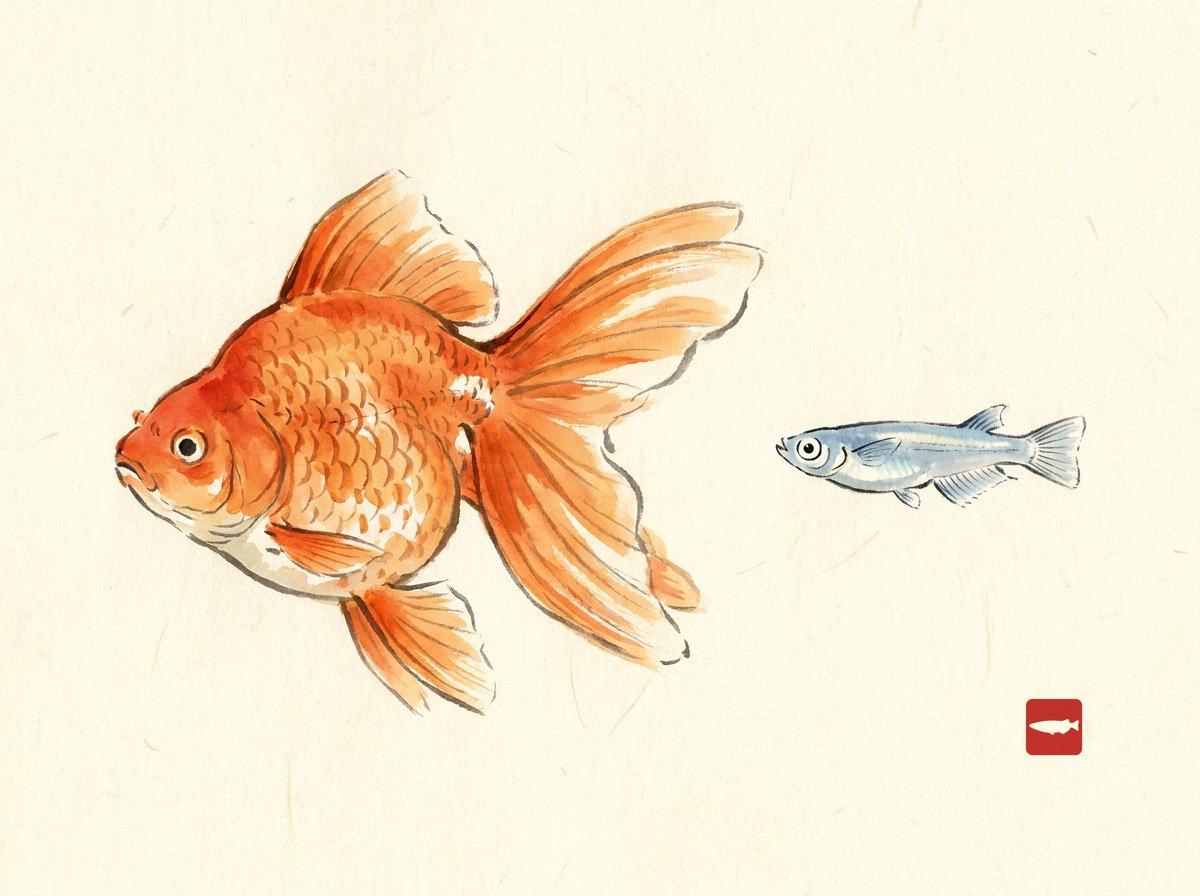
Same hobby, very different animals. One of these outgrows a patio pot. My illustration.
The deciding factor: waste and water volume
The one thing that settles this for most backyards is bioload, how much waste a fish puts into the water. Goldfish are famously messy. They eat constantly and produce a lot of ammonia, which is toxic to fish as it builds up. In a big pond with heavy filtration that ammonia gets diluted and processed. In a half-barrel or patio tub it doesn't, it accumulates fast, the water fouls, and the goldfish (and anything with them) suffers.
Medaka are the opposite: tiny, light-feeding fish with a very low bioload. A modest group sits comfortably in the same tub that a single goldfish would quickly overwhelm, which is exactly why medaka have been the traditional container-pond fish in Japan for centuries.
Where koi fit, and where they do not
Koi belong in this comparison because they are what people reach for next after goldfish, and the mismatch is even sharper. A koi is not a large goldfish, it is a different scale of animal. They routinely reach two to three feet and keep growing for years, so the fish that looks manageable in a bag at the store is a long-term commitment to a real pond with real filtration.
The trouble is that koi are sold small. A six inch koi in a patio tub looks fine for one season, which is exactly why it is such a common mistake. It is not a fish that outgrows its container gracefully. It outgrows it completely.
None of that makes koi a bad fish. If you have a proper pond with the volume, depth, and filtration to support them, koi are wonderful, long-lived animals and there is nothing medaka can do that will replace them. But if you are reading this while planning a half-barrel or a stock tank on a patio, koi are not the answer to that question, and neither are goldfish.
Guppies: the right size, the wrong climate
Guppies are the closest thing to medaka on this list. Same rough size, same light bioload, same easy temperament, and they eat mosquito larvae just as happily. If you are choosing a small colorful fish for a ten gallon tank indoors, guppies are a genuinely good answer and I will not pretend otherwise.
The difference is temperature. Guppies are tropical. They want water in the seventies and they do not overwinter outdoors anywhere that gets a real winter. Medaka evolved in Japanese rice paddies that freeze at the top and bake in summer, so the same tub that kills a guppy in November is where medaka spend the whole year.
So a guppy tub does work, right up until the first cold snap. If your plan is a patio container that lives outside through the seasons, that is the whole argument. If your plan is a heated tank in the living room, guppies are a fine choice and the comparison is much closer.
Both handle cold, so why not goldfish in a tub?
Here's the overlap: both medaka and goldfish are cold-hardy and can overwinter outdoors in much of the US, slowing down through winter and even sitting under a lid of ice, provided the container holds enough water to buffer the cold (my outdoor guide covers what that takes). That's why people reach for goldfish for a patio pond in the first place.
The problem isn't temperature, it's size and waste. A comet goldfish that starts as a two-inch feeder can reach ten inches or more, and it produces waste to match. A patio tub that looks fine in spring becomes badly overstocked by late summer. Medaka stay small their whole lives, so the tub that fits them in April still fits them in September.
Plants and mosquitoes
A planted tub is the easiest kind to keep, and this is another split. Goldfish treat soft plants as salad and dig through substrate, so a planted goldfish tub is an ongoing battle. Medaka leave plants entirely alone, the floating plants that come free with every fish or snail order just keep growing and doing their job. Medaka are also relentless mosquito-larva hunters at the surface, which makes a medaka tub a quiet form of pest control; a goldfish in muddy, understocked water is far less effective at it.
Can you keep them together?
Not a good idea. A grown goldfish is big enough to eat adult medaka, and the two want completely different water: goldfish need volume and heavy filtration to deal with their waste, while medaka want calm, still, lightly filtered water. If you have a large, well-filtered pond, goldfish are a fine choice on their own. For anything tub-sized, medaka are the better fish, pair them with a few snails for cleanup instead.
My verdict
Goldfish have one real home: a large, established pond with the volume and filtration to absorb how much waste they produce. If that's what you have and you want big, classic pond fish, they work.
Given the choice, though? I'd still take medaka, even for the pond. Because they stay small and clean, you can keep a whole shimmering colony where a pond fits only a handful of goldfish; they leave your plants alone, eat mosquitoes, breed into a self-sustaining group, and overwinter outdoors just the same. For a patio tub, a half-barrel, or an unheated tank it isn't close, and for a full pond it's simply the fish I'd rather watch. I raise medaka, so of course I'm biased, but that's a genuine preference, not a sales pitch.
Hand-picked varieties and mixed collections, shipped with free floating plants and my live arrival guarantee, the low-waste, cold-hardy fish a small pond is built for.
Shop Fish Varieties