Medaka Fry Care
Medaka fry are easy to hatch and easy to lose in the first two weeks. Almost every loss comes down to two things: being eaten, or being offered food too large to fit in a mouth about a millimeter wide. Solve those and the rest is mostly patience.
Getting eggs to hatch
Fertilised medaka eggs are small, round, and surprisingly tough. You can move them by hand, which is what makes this species so rewarding to breed. Move them into their own container of clean water from the same system, and keep it shallow and warm.
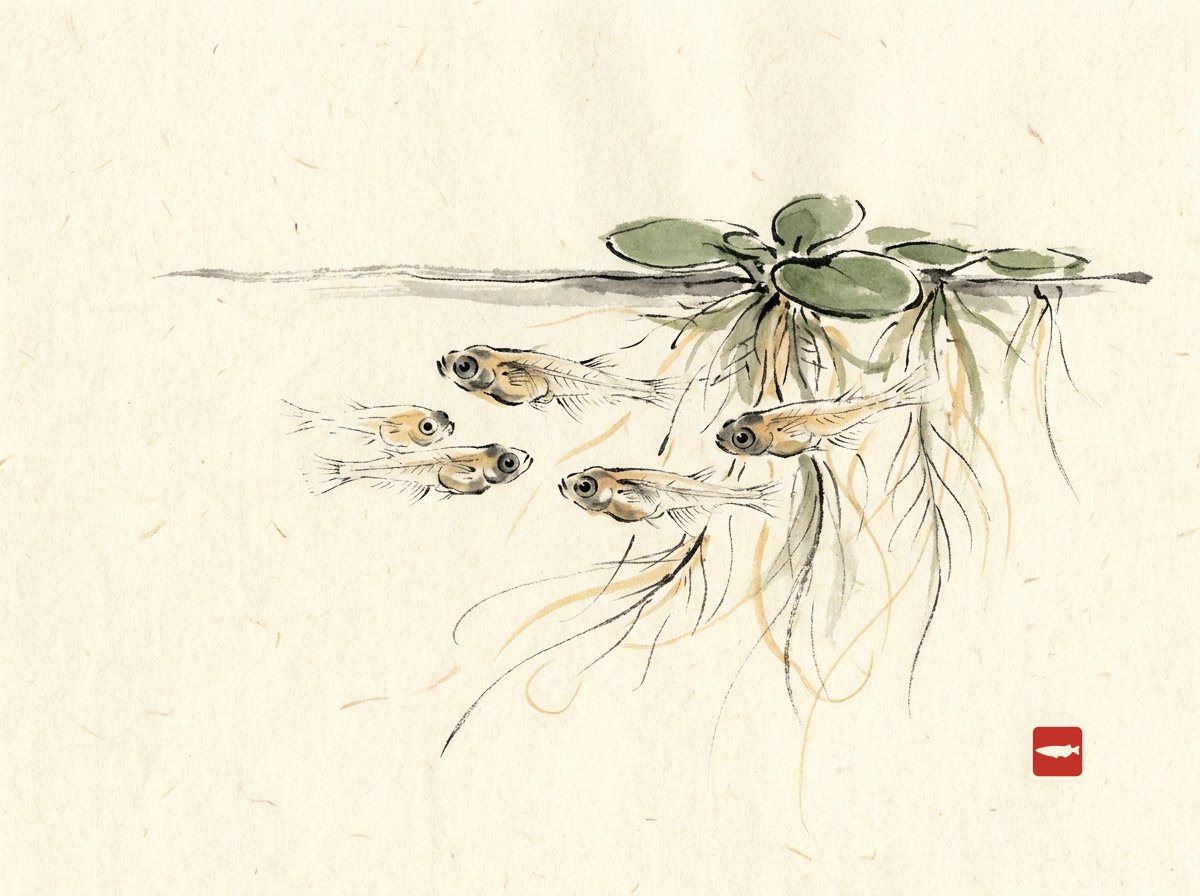
All eyes at that age. Fry live where the roots are. My illustration.
Hatching runs on accumulated warmth rather than a fixed calendar. In the mid to high seventies Fahrenheit expect roughly nine to eleven days; cooler water takes noticeably longer. Eggs that turn opaque white are not developing and should be removed, since they grow fungus that can spread to healthy eggs beside them.
Mistake one: leaving them with the adults
Adult medaka eat their own fry. Not out of malice, they are surface feeders and a newly hatched fry is the right size and in the right place. In a bare container almost none survive.
You have two options. Separating them gives the highest survival: move eggs or newly hatched fry into their own container. Or leave them and plant heavily, since in a tub thick with floating plant roots a decent number will hide successfully and grow up. That is the hands-off approach and it does work, you simply get fewer.
Mistake two: food they cannot eat
A newly hatched medaka is about the size of an eyelash. Adult pellets, even crushed, are often still too big, and fry starve surrounded by food. They need powdered fry food or infusoria at first, then freshly hatched baby brine shrimp once they can swallow it, usually somewhere between day four and day ten.
Feed small amounts several times a day. Fry have almost no reserves and grow fast, so frequency matters more than quantity. Their container should also be green rather than sterile: a jar with some plant matter and a little algae grows the microscopic life fry graze on constantly between feedings, and that background grazing carries them through the first week better than any scheduled feeding does.
The first month
Keep the water shallow, which puts food within easy reach of weak swimmers, and keep it stable. Skip the filter entirely, or use a very gently run sponge, since anything with real intake will kill fry. Small, frequent water changes beat large ones, and pour slowly.
Expect uneven growth. Some fry shoot ahead, and because larger medaka will eat smaller ones once the size gap is wide enough, it is worth sorting by size as they grow if you want to keep the whole batch. By around four to six weeks they look like miniature adults and can join a grow-out container.
When they can join the adults
The test is simple: once a young fish is too big to fit in an adult's mouth, it is safe. In practice that is usually somewhere around three quarters of an inch to an inch. If in doubt, wait, since there is no cost to leaving them another fortnight and a real cost to moving them early.
Young medaka can reach breeding age within a few months in warm weather, so a spring hatch often spawns before its first winter. My breeding guide covers the adult side of the cycle, and my feeding guide covers what to move them onto.
Females wipe their eggs onto the yarn, so you lift the whole mop into a hatching container and drop a spare back in. These are the exact mops I use in my own breeding program.
Shop Spawning MopsCommon questions
How long do medaka eggs take to hatch?
Roughly nine to eleven days in the mid to high seventies Fahrenheit, longer in cooler water, since development runs on accumulated warmth rather than a fixed number of days. Eggs that turn opaque white are not developing and should be removed before fungus spreads.
Will adult medaka eat their babies?
Yes. Adults are surface feeders and newly hatched fry are the right size and in the right place. Either separate the eggs or fry into their own container, which gives the best survival, or plant the tub heavily so some fry can hide and grow up.
What do medaka fry eat?
Food far smaller than adult pellets: powdered fry food or infusoria at first, then freshly hatched baby brine shrimp once they can swallow it, usually between day four and day ten, fed in small amounts several times a day. A container with some plant matter and algae also gives fry microscopic life to graze on continuously.
When can baby medaka join the adults?
Once they are too large to fit in an adult's mouth, usually around three quarters of an inch to an inch, often six to eight weeks in warm water. If you are unsure, waiting longer costs nothing.